Most glider pilots know that for each wind condition there is one, and only one, speed to fly that will maximize performance. Maximum performance being defined as the least amount of altitude lost, or the most altitude gained for a given task. If there were no wind or sink there would be, essentially, two speeds to fly - minimum sink speed and maximum Lift/Drag speed. When sink or a head wind is encountered a pilot will want to fly faster than the best glide speed in order to maximize performance. The question is, "How much faster"? This article will use performance data from the flight manuals of the Schweizer 2-33 and the Blanik L-13 to make this determination for different wind/sink combinations. This data is already available for the Schweizer 1-26 in Appendix A of "The Joy of Soaring"1. It should be noted that on a cross country flight, speed over the course may be more important than optimal performance - at least, while the conditions remain good. If the lift weakens or you get low, performance becomes more important.
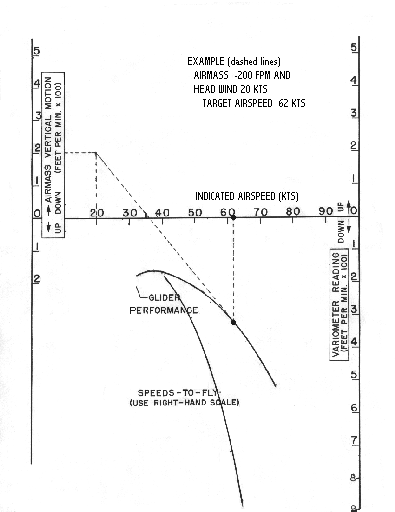
In the following graphs, the glider performance curve was plotted directly from the manufacturer supplied data. The speeds-to-fly curve was computed as per the instructions in Appendix A of "The Joy of Soaring". The Appendix makes two key points:
- The airspeed and variometer data are convergent. That is, the pilot flying a 2-33 solo at 47 mph notices that the vario indicates 350 fpm down (stable air at 47 mph would indicate 190 down). The speeds-to-fly curve shows that this requires a speed of 52 mph. However, when the speed is pushed to 52, the vario will show even more down due to the increased sink rate at the higher speed. This will indicate an even higher speed to fly on the speeds-to-fly curve - but this speed is only slightly higher. After several iterations, the airspeed and vario reading will "come together" and match the speeds-to-fly curve and in practice, this is a fairly smooth and quick process.
- Erring on the side of more speed is better than erring on the side of less speed. You will lose less altitude if you fly too fast through sink than if you fly too slow.
Let's look at the glide performance data for the 2-33 flown solo (see figure 1). If the airmass is sinking at 200 feet per minute, we see that we need to fly at about 55 mph in order to minimize lost altitude (remember that best L/D in "dead air" is at 47 mph). This is all well and good. However, you as the pilot, don't know the vertical speed of the sinking airmass. All that you have is a variometer that measures the vertical speed of the airmass plus the sink rate of the glider. If we now shift our attention the speeds-to-fly curve, we will see that under the above conditions, our vario will be indicating about 420 fpm down (see the dotted lines for an example). If your vario indicates 900 down, you should be be flying at 68 mph, and, if the vario is pegged down, you need to fly faster still. There are variometers that measure the vertical speed of the airmass and called are netto variometers7.
The glider performance curve can also be used to determine how fast to fly into a headwind in order to maximize the distance over the ground with the least amount of altitude lost2, 4. If we think of the horizontal axis of the graph to be wind speed, instead of indicated airspeed, we simply draw a line from the wind speed to the tangent of the performance curve. The example in figure 2 shows that if we're flying into a 20 mph headwind , the speed to fly is 57 mph. If we extend the horizontal axis to the left of the vertical axis we can extend the concept to calculate the speed to fly in a tailwind as well3. If, in the above example, we change the 20 mph headwind into a 20 mph tailwind, our speed to fly becomes 48 mph. Note that the minimum sink speed is 43 mph and best L/D is at 52 mph. If you are faced with a headwind and a sinking airmass, the speed to fly is solved by the example shown in figure 34. If you don't have graphs available, all is not lost. A good rule of thumb is to add 1/2 of the wind speed to your best L/D speed when penetrating a headwind5. Judging from the performance curves in this article, this is a very good rule of thumb.
When you look at the two graphs for the 2-33 it is immediately obvious how much weight (wing loading) affects performance - and why many ships have provisions for adding water. For instance, the max. L/D (22:1) at 790 pounds (solo), is at 47 mph. Bump the weight up to 1040 pounds (dual) and the max. L/D speed is at 51 mph. The actual L/D of 22.2:1 is the same at both weights - the only difference is the speed at which it occurs. When we push the speed of the 2-33 up to 75 mph, the solo glider will fly at 13.3:1 but the dual glider will be flying at 16.2:1. Nothing is aviation is free. Higher weight means that you'll have a higher minimum sink rate. This is why water carrying ships flying cross-country will dump their load when the conditions get weak - when the lift decreases, you want to minimize sink rate.
When flying cross country, you have to look at a bigger picture. Instead of maximizing performance of the glider for the air that you're currently flying in, you need to look ahead. For instance, if you see what you expect to be a boomer of a thermal forming some miles ahead, you may want to fly faster than the optimum airspeed for the current air so that you'll get to your thermal while its still cooking. Interested readers may want to read up on the "MacCready Speed Ring6". THE ultimate source for speeds to fly and cross country soaring in general is Helmut Reichmann’s "Cross-Country Soaring". It's available from the SSA - get it!
References
1. Conway, Carle. "The Joy of Soaring". Soaring Society of America. 1969. Appendix A.
2. Knauff, Thomas L. "Glider Basics - From Solo to License". 1984. Page 101.
3. Reichmann, Helmut. "Cross Country Soaring". Thompson Publications. 1978. Page 98.
4. Piggott, Derek. "Gliding, A Handbook on Soaring Flight". A. and C. Black Ltd. 1968. Figure 47.
5. "Soaring Flight Manual". Jeppesen Sanderson, Inc. 1984. Page 2-7.
6. Knauff, Thomas L. "Glider Basics - From Solo to License". 1984. Page 106."7. Knauff, Thomas L. "Glider Basics - From Solo to License". 1984. Page 116.
FIGURE 1 - Schweizer 2-33A 790 pounds (solo)
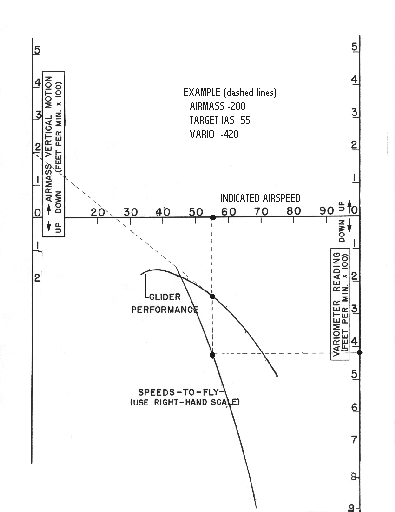
FIGURE 2 - Schweizer 2-33A 1040 pounds (dual)
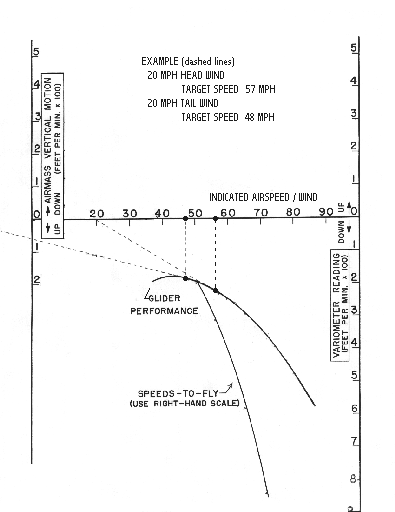
FIGURE 3 - Blanik L-13 1040 pounds